Bad adverb! Very bad …

Like perfume, the smallest application of adverbs is plenty.

  • “The road to hell is paved with adverbs.” ~ Stephen King
  • “Adverbs are the tool of the lazy writer.” ~ Mark Twain
  • “In order to write good stuff you have to hate adverbs.” ~ Theodore Roethke
  • “… the beastly adverb – far more damaging to a writer than an adjective.” ~ Graham Greene
  • “It’s an adverb, Sam. It’s a lazy tool of a weak mind.” ~ Casey Schuler in Outbreak.

So, What Is an Adverb Anyway?

Planets
As the name implies, “adverbs” modify verbs, i.e. add + verb = adverb. Adverbs also modify adjectives, other adverbs, phrases, clauses, and whole sentences. Adverbs can modify just about anything in a sentence – except a noun.

Because there are almost as many adverb types as planets in our solar system, I narrowed the scope of this discussion to those adverbs that end in –ly. This includes adverbs like airily, basically, blissfully, convincingly, drowsily, flirtatiously, harshly, horribly, lovingly, quickly, restlessly, shrewdly, smilingly … like that. (For an extensive list of 3732 adverbs, go here.)

Since Adverbs are so Plentiful, Why are They Scorned?
For the fiction writer, their use of adverbs can mean the difference between a manuscript being published or getting tossed in the recycle bin. Why? Because adverbs are weak, especially those that end in –ly. Instead of adding depth, meaning, or action to a sentence, they slow it down. In fiction, adverbs can even make the reader feel insulted, rather like the author is inserting himself into the story to TELL the reader “how it is being done” or “what this really means.”

Good writers (e.g. tight writers) find the right verb, a strong verb, that will SHOW the reader what is going on. Like a magnet, strong verbs pull the reader into the story, making him or her a part of the drama. Adverbs can’t do that.

Strong Verbs: The Sign of Good Writing
The preferred method for conveying meaning, depth or activity in a sentence is by using a strong, fitting, effective verb. Sentences that contain well-chosen, action-packed, meaning-laden verbs don’t need adverbs.

One strong verb does a much better job of helping readers feel the action or meaning than a whole cosmos of adverbs. Case in point: which of the following sentences feels stronger:

1. Little Anthony ran quickly across the field.
2. Little Anthony sprinted across the field.

The second one, right? The second sentence can be summed up in two words: Anthony + sprinted. Readers have to work at visualizing the action in the first sentence, while in the second sentence, the action flows.

Here’s another example:
When the mouse slowly walked from behind the bookcase, the cat swiftly ran after it.

Yawn. See how the writer used adverbs to pump up the wimpy verbs (walk and run).

Let’s rewrite that sentence with stronger verbs:
When the mouse crept from behind the bookcase, the cat sprang after it.

See the difference? Feel the difference? Descriptive verbs pull in your readers, making them want to read what happens next, and what happens after that.

Tight Writers Show More Action with Fewer Words
Successful writers look high and low until they find the right verb that conveys the right emotion or elicits the right visualization for their readers. Good writers search for that perfect verb to convey their meaning, because the perfect verb says it all and does not need a modifier.

Many successful (i.e. published, best-selling) writers admit that as they improved their writing skills, they learned how to write with fewer adverbs.

Back to the Perfume Analogy
As a contract technical writer I often work on client sites. Along with my temporary badge, I’m handed an instruction sheet that lists “appropriate attire” and “acceptable behavior” for this workplace – like no shorts, no sandals, no halter tops, and no perfume. The first time I saw the “no perfume” restriction, I was surprised. Dabbing on a bit of perfume had always been part of my morning ritual, and now I had to leave that part out.

“Leaving that part out” is what writers need to do if they want to win writing contests, get published, and have readers who just “love” their writing. This is what successful writers learn to do with -ly adverbs: They learn to leave them out.

How Do You “Leave Them Out”?
You might be wondering how you are going to write descriptive prose if you don’t use adverbs. Find stronger verbs.

Here’s an action sentence with an adverb:
With that, Louise vehemently walked out of the room.
What’s the verb in that sentence? Walk, a mundane verb if there ever was one.

Action sentence without an adverb:
With that, Louise stamped out of the room.
With a verb like “stamp” to show how Louise left the room, the sentence doesn’t need or want an adverb. “She stamped” conveys all the mood required.

Never Use Adverbs?
I’m not advocating that you never, ever use adverbs. Just don’t use them often. Sometimes you can’t help but use an adverb because no amount of verb hunting gets you where you want to go. If you try to get around an -ly adverb and can’t, then go ahead, leave it in.

Just remember: According to many writing teachers, a good rule of thumb for adverb use in adult fiction is about one per chapter. According to some editors, one adverb per every 100 pages is about right.

Next time, more tips on writing without adverbs.
[Note: I realize that the title of this post contains one of the worst adverbs - very. This was intentional. :-) ]

Happy Writing!
Ann
(c) March 12, 2012

Posted in Uncategorized | Tagged , , , , , | 5 Comments

How to Deflate those Inflated Phrases

Inflated hot air balloons
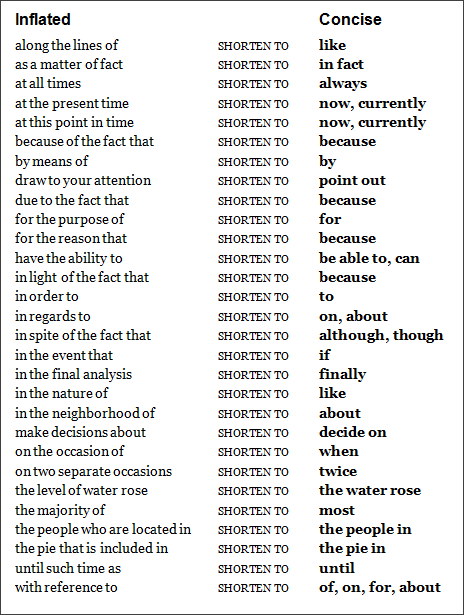
Effectual writers tighten their writing by transforming inflated phrases into shorter, more concise terms. This way they convey the same information with fewer words. This article examines how to recognize inflated phrases and how to deflate them.

Inflation
Although inflation is great for balloons, it isn’t good for sentences. Most of today’s readers prefer the work of efficient writers who don’t waste their reading time. That’s one reason tight writers are so valuable! They keep their readers happy by replacing wordy, antiquated phrases with concise terms.

Examples
These sentences contain inflated phrases that we often hear people say, but which should not invade our writing.

(1) Next month the interns will do a study on the declining bee population.
Better: Next month the interns will study the declining bee population.

(2) Before the election Thomas will provide a summary of the survey results.
Better: Before the election Thomas will summarize the survey results.

(3) The new clerk has a tendency to misfile client applications.
Better: The new clerk tends to misfile client applications.

(4) The new policy will serve to make reductions in paper waste.
Better: The new policy will reduce paper waste.

(5) In the event that Ms Potter cannot attend the meeting, mail her a copy of the plan.
Better: If Ms Potter cannot attend the meeting, mail her a copy of the plan.

(6) The numbers shown in the spreadsheet offer the proof we need.
Better: The numbers in the spreadsheet offer the proof we need.

(7) He refuses to attend practice in spite of the fact that it would be good for him.
Better: He refuses to attend practice although it would be good for him.

(8) She earned in the neighborhood of $100,000.
Better: She earned about $100,000.

(9) Hire someone who has the ability to create flowcharts.
Better: Hire someone who can create flowcharts.

(10) Because of the fact that he stays up late, he doesn’t get enough sleep.
Better: Because he stays up late, he doesn’t get enough sleep.

Replacements for Inflated Phrases

Make each word in a sentence carry its own weight.

List of Inflated terms

Tight writing not only saves on printing costs, but increases the likelihood that your document will actually be read!

Happy Writing!
Ann
(c) February 2, 2012

Posted in Uncategorized | Tagged , , , , , | 6 Comments

How to Fix a Dangling Participle

Refresher
A dangling participle is a modifier that’s in the wrong place for the noun it is supposed to describe. This means:

  • The modifier is too far away from what it is supposed to describe, or
  • Another noun got in the way and the modifier clung to it instead of the intended noun, or
  • The noun the modifier is supposed to modify isn’t in the sentence.

San Juan RiverSome instructors, judges and editors believe dangling participles are the most egregious writing mistake because they cause readers so much grief trying to decipher the writer’s intentions.

In Other Words …
Mentally, readers expect a participle to modify the person, place or thing that immediately follows it, and when that construction isn’t logical, the writer leaves both the participle, and the reader, dangling.

So, what does this mean to the grammar-challenged? It means they need to be able to recognize and fix a dangling participle, just in case one slips into their writing. Most dangling participles are fairly easy to fix but recognizing them takes practice. Here are some tips for recognizing sentences with dangling participles:

  • Make sure the action in the sentence is actually attached to the person or thing doing it.
  • Read your draft aloud before you submit it. The stresses and pauses will help you recognize when something doesn’t quite sound right.
  • Have someone else read the draft, someone whose reading skills you trust.
  • Make sure all participial forms are immediately preceded or followed by the nouns they modify.

Examples
Let’s analyze and fix some of the sentences from the previous post:

(1) After rotting in the cellar for weeks, my brother brought out some shrivelled potatoes.

·   Modifier: After rotting in the cellar for weeks
·   What the writer wanted to modify: some shriveled potatoes
·   What is actually being modified: my brother
·   Discussion: Fix the sentence so that the brother hasn’t been rotting in the cellar.
Fix 1: My brother brought out some shrivelled potatoes that had been rotting in the cellar for weeks.
Fix 2: After rotting in the cellar for weeks, the potatoes had shrivelled. (Good, although it leaves out the brother.)

(2) Looking out over his yard, the deer nibbled on his grape vines.
·   Modifier: Looking out over his yard
·   What the writer wanted to modify: Whoever was looking out over his yard (missing)
·   What is actually being modified: the deer
·   Discussion: Fix the sentence so the man who owns the yard immediately follows the modifier.
Fix 1: Looking out over his yard, Bob could see the deer nibbling on his grape vines.
Fix 2: As he looked out over his yard, the owner saw the deer nibble his grape vines.

(3) At the age of 12, her father passed away.
·   Modifier: At the age of 12
·   What the writer wanted to modify: the girl (missing)
·   What is actually being modified: her father
·   Discussion: Fix the sentence so the father doesn’t die at the age of 12.
Fix 1: At the age of 12, the girl lost her father who passed away.
Fix 2: Sarah’s father passed away when she was 12 years old.

(4) Driving south through Bluff, the San Juan River appeared on my left.
·   Modifier: Driving south through Bluff
·   What the writer wanted to modify: Whoever was driving
·   What is actually being modified: the river (which appears to be driving)
·   Discussion: Add the driver and reword the sentence so that a person is driving and not the river.
Fix 1: As I drove south through Bluff, the San Juan River appeared on my left.
Fix 2: Driving south through Bluff, I saw the San Juan River on my left.
(P.S. That’s the San Juan River in the photo above.)

Fun, huh? :-)

Attached is a PDF with the examination, description and fixes for eight more sentences. Click to open the file.  MoreFixesforDanglingParticiples

Happy Writing!
Ann
(c) January 19, 2012

Related topics:
Dangling Participles May Be Funny, But …

Posted in Uncategorized | Tagged , , , , , | 3 Comments

Dangling Participles May Be Funny, But …

Two deer eating grape vines
If ever there is a time that readers will stop and ask themselves, “Now, what was that!?” it will happen after they read a sentence with a dangling participle. But even though dangling participles are confusing and are certainly poor form, the unintended consequence can be worth a chuckle!

12 Dangling Participles
Check out these examples:

(1) After rotting in the cellar for weeks, my brother brought out some shrivelled potatoes.


(2) Looking out over his yard, the deer nibbled on his grape vines.


(3) At the age of 12, her father passed away.


(4) After running five red lights, the police officer stopped the speeding motorist.


(5) Driving south through Bluff, the San Juan River appeared on my left.


(6) After sitting in the freezer for three hours, my mother served the ice cream cake roll.


(7) Riding to the soccer field, a pothole nearly wrecked my bike.


(8) After being thoroughly beaten, the chef cooked the eggs. 


(9) Rushing from the restaurant, the crystal sugar bowl fell out of her pocket.


(10) Featuring four GB of memory, we can strongly endorse this computer’s graphic potential.


(11) Counting his money for the second time, the clock chimed 10 o’clock.


(12) Listening to Chopin, the truck moved gracefully through traffic.

Did you sense that something was wrong with these sentences as you read them? Good! With each of these sentences the subject of the participle is either missing or misplaced

Definitions
Okay, what’s a participle? It is an adjective that ends with -ing (and sometimes -ed). Basically, the primary role of an adjective is to modify a noun. The problem is … adjectives (including participles) have a strong desire to cling to a noun, and this desire is so strong that they will attach themselves to the closest noun they find in the sentence, even if it is the wrong noun.

And then, what is a dangling participle? It is a participle (word or phrase) that has been left “dangling” because it isn’t clear what the participle is supposed to modify. Some times, the noun that the participle is supposed to modify has been left out.

Dangling participles may occasionally add humor to your writing, but most assuredly they will confuse the daylights out of your readers. Unless that is your goal (for some reason), I don’t think confusing your readers is a good thing …

Next time we’ll discuss what is wrong with the sentences above, how to tell that they contain dangling participles, and how to fix them!

Have a Happy New Year!
Ann
(c) December 21, 2011

Related topics:
How to Fix a Dangling Participle

Posted in Uncategorized | Tagged , , , , | 11 Comments